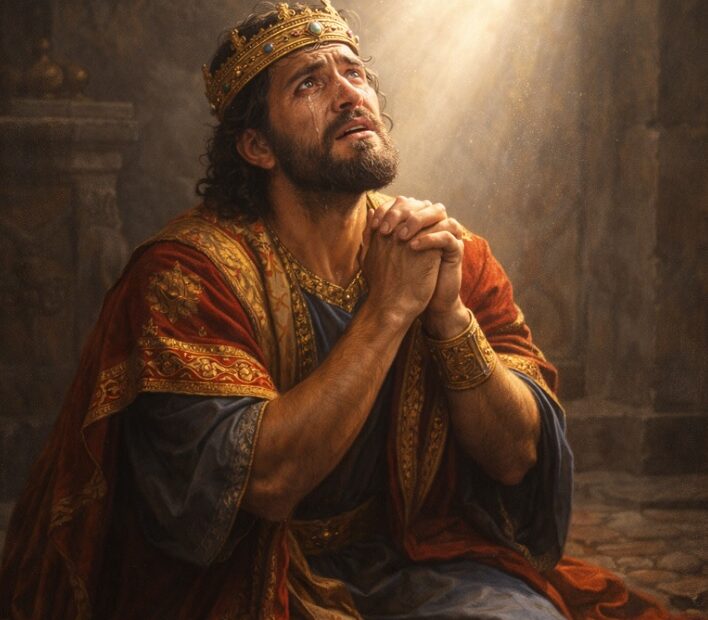
“Dizendo: Pai, se queres, passa de mim este cálice; todavia não se faça a minha vontade, mas a tua.”. – Lucas 22:42
Davi não era perfeito ou sem pecado. A Bíblia não esconde suas falhas graves, mas destaca algo essencial: Davi tinha um coração sensível à voz de Deus. Ele buscava ao Senhor com sinceridade, desejava agradá-Lo e colocava Deus acima de si mesmo. Veja o que diz em Salmos 63:1 “Ó Deus, tu és o meu Deus, de madrugada te buscarei; a minha alma tem sede de ti; a minha carne te deseja muito em uma terra seca e cansada, onde não há água;”.
Quando Davi pecou, ele não tentou justificar o erro nem endureceu o coração. Ao ser confrontado pelo profeta Natã, reconheceu seu pecado, arrependeu-se profundamente e humilhou-se diante de Deus. Veja o que diz em 2ª Samuel 12:13 “Então disse Davi a Natã: Pequei contra o Senhor. E disse Natã a Davi: Também o Senhor perdoou o teu pecado; não morrerás.”.
Ser segundo o coração de Deus não significa nunca cair, mas saber voltar para Deus após a queda. Davi entendeu que Deus se agrada mais de um coração quebrantado do que de aparências religiosas. Veja o que diz em 1ª João 1:9 “Se confessarmos os nossos pecados, ele é fiel e justo para nos perdoar os pecados, e nos purificar de toda a injustiça.”.
Quer saber mais sobre este assunto? Veja em:
 English Translation
If David Sinned, How Was He a Man After God’s Own Heart?
“Saying, Father, if thou be willing, remove this cup from me: nevertheless not my will, but thine, be done.” – Luke 22:42
David was not perfect or sinless. The Bible does not hide his serious flaws, but it highlights something essential: David had a heart sensitive to God’s voice. He sought the Lord with sincerity, desired to please Him, and placed God above himself. As it says in Psalm 63:1: “O God, thou art my God; early will I seek thee: my soul thirsteth for thee, my flesh longeth for thee in a dry and thirsty land, where no water is.”
When David sinned, he did not try to justify his mistake or harden his heart. When confronted by the prophet Nathan, he recognized his sin, repented deeply, and humbled himself before God. As it says in 2 Samuel 12:13: “And David said unto Nathan, I have sinned against the Lord. And Nathan said unto David, The Lord also hath put away thy sin; thou shalt not die.”
Being after God’s own heart does not mean never falling, but knowing how to return to God after the fall. David understood that God is more pleased with a broken heart than with religious appearances. As it says in 1 John 1:9: “If we confess our sins, he is faithful and just to forgive us our sins, and to cleanse us from all unrighteousness.”
 中文翻译(简体)
如果大卫犯了罪,他怎么会是“合神心意的人”呢?
“说:父啊!你若愿意,就把这杯撤去;然而,不要成就我的意思,只要成就你的意思。” —— 路加福音 22:42
大卫并非完美无缺,也不是没有罪。圣经并没有掩饰他的严重过错,但它强调了一个核心点:大卫有一颗对神的声音敏锐的心。他诚心地寻求主,渴望取悦祂,并将神置于自己之上。正如诗篇 63:1 所说:“神啊,你是我的神,我要切切地寻求你;在干旱疲乏无水之地,我的灵魂渴想你,我的肉身切慕你。”
当大卫犯罪时,他没有试图为自己的错误辩解,也没有硬着心。当先知拿单指责他时,他承认了自己的罪,深刻悔改,并在神面前谦卑自己。正如撒母耳记下 12:13 所说:“大卫对拿单说:‘我得罪耶和华了!’拿单说:‘耶和华已经除掉你的罪,你必不至于死。’”
“合神心意”并不意味着永不跌倒,而是意味着在跌倒后懂得如何回到神身边。大卫明白,神喜爱忧伤痛悔的心,胜过宗教的外表。正如约翰一书 1:9 所说:“我们若认自己的罪,神是信实的,是公义的,必要赦免我们的罪,洗净我们一切的不义。”