
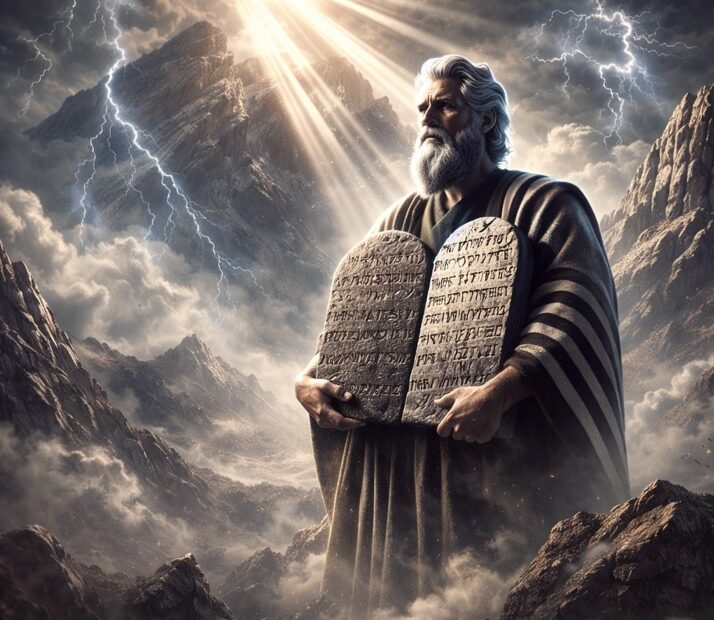
“E aquelas tábuas eram obra de Deus; também a escritura era a mesma escritura de Deus, esculpida nas tábuas.”. – Êxodo 32:16
No alto do monte Sinai, Moisés não negociou nada com Deus. Os mandamentos não surgiram de um acordo humano, mas foram dados diretamente pelo próprio Deus como expressão da Sua santidade e da Sua vontade para o povo. Moisés apenas recebeu e transmitiu aquilo que Deus já havia determinado. Veja o que diz em Êxodo 24:12 “Então disse o Senhor a Moisés: Sobe a mim ao monte, e fica lá; e dar-te-ei tábuas de pedra, e a lei, e os mandamentos que escrevi, para os ensinar.”.
Mais tarde, Jesus ensinou que os mandamentos apontam para dois princípios centrais: amar a Deus e amar ao próximo. Esses dois resumem toda a Lei. Veja o que diz em Mateus 22:37–40 “Amarás o Senhor teu Deus de todo o teu coração, … Amarás o teu próximo como a ti mesmo. Destes dois mandamentos dependem toda a lei e os profetas.”.
Hoje, os que creem em Cristo não vivem mais debaixo da condenação da Lei, mas debaixo da graça. A Lei revelou o pecado, mas a salvação vem pela fé em Jesus, que cumpriu perfeitamente a Lei em nosso lugar. Veja o que diz em Romanos 6:14 “Porque o pecado não terá domínio sobre vós, pois não estais debaixo da lei, mas debaixo da graça.”.
Quer saber mais sobre este assunto? Veja em:
English Translation
Did Moses Negotiate the Number of Commandments with God?
“The tablets were the work of God; the writing was the writing of God, engraved on the tablets.” – Exodus 32:16
Atop Mount Sinai, Moses did not negotiate anything with God. The commandments did not arise from a human agreement but were given directly by God Himself as an expression of His holiness and His will for the people. Moses simply received and transmitted what God had already determined. See what it says in Exodus 24:12: “The Lord said to Moses, ‘Come up to me on the mountain and stay here, and I will give you the tablets of stone with the law and commandments I have written for their instruction.’”
Later, Jesus taught that the commandments point to two central principles: loving God and loving your neighbor. These two summarize the entire Law. See what it says in Matthew 22:37–40: “‘Love the Lord your God with all your heart… Love your neighbor as yourself.’ All the Law and the Prophets hang on these two commandments.”
Today, those who believe in Christ no longer live under the condemnation of the Law, but under grace. The Law revealed sin, but salvation comes through faith in Jesus, who perfectly fulfilled the Law in our place. See what it says in Romans 6:14: “For sin shall no longer be your master, because you are not under the law, but under grace.”
中文翻译(简体)
摩西曾与上帝讨价还价诫命的数量吗?
“法版是上帝的工作,字是上帝写的,刻在版上。” —— 出埃及记 32:16
在西奈山顶,摩西没有与上帝进行任何谈判。诫命并非源于人类的协议,而是由上帝亲自赐予的,是祂的圣洁和对子民旨意的体现。摩西只是接受并传达了上帝已经决定的内容。正如出埃及记 24:12 所说:“耶和华对摩西说:‘你上山到我这里来,住在这里,我要将石版以及我所写的律法和诫命赐给你,使你可以教导他们。’”
后来,耶稣教导说,诫命指向两个核心原则:爱上帝和爱邻舍。这两条总结了所有的律法。正如马太福音 22:37–40 所说:“‘你要尽心……爱主你的上帝。要爱邻如己。’ 这两条诫命是律法和先知一切道理的总纲。”
今天,信奉基督的人不再活在律法的定罪之下,而是活在恩典之下。律法揭示了罪,但救赎是通过对耶稣的信心而来的,祂代替我们完美地履行了律法。正如罗马书 6:14 所说:“罪必不能作你们的主,因你们不在律法之下,乃在恩典之下。”
