
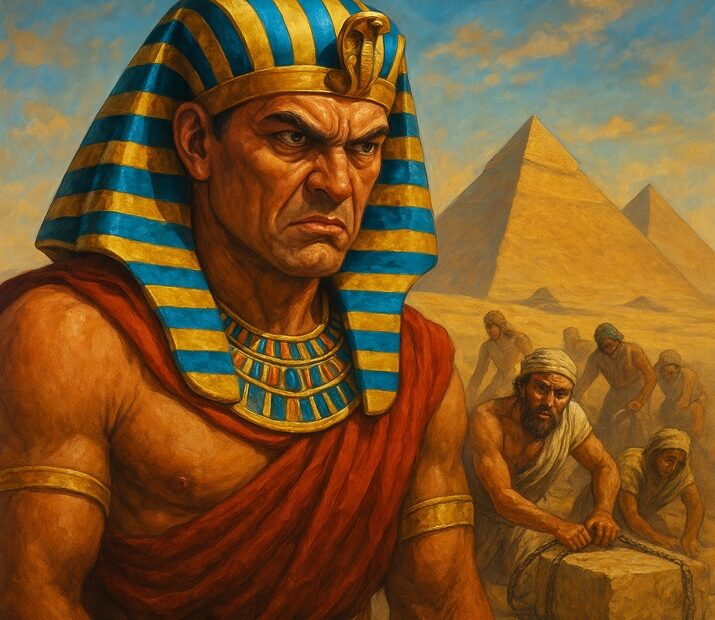
“Porém o Senhor endureceu o coração de Faraó, e este não os quis ouvir, como o Senhor tinha dito a Moisés.” – Êxodo 9:12
A Bíblia mostra que o coração de Faraó já era orgulhoso e resistente à vontade de Deus (Êxodo 5:2). Quando o texto diz que Deus o endureceu, não significa que Faraó era inocente e foi forçado a pecar, mas que o Senhor confirmou a rebeldia que ele mesmo havia escolhido. O objetivo de Deus com isso era mostrar Seu poder ao Egito, confirmar sua promessa a Israel e permitir que o mundo inteiro testemunhasse.
O apóstolo Paulo explica isso em Romanos 9:17: “… Para isto mesmo te levantei; para em ti mostrar o meu poder, e para que o meu nome seja anunciado em toda a terra.” Ou seja, cada praga e cada ato de resistência de Faraó serviram para revelar que o Deus de Israel era superior a todos os deuses do Egito. O endurecimento do coração de Faraó foi um instrumento de Deus para que a libertação acontecesse de maneira grandiosa, fortalecendo a fé de Israel e deixando um testemunho eterno.
Esse mesmo princípio aparece em Romanos 1:28, onde Paulo fala que, por rejeitarem a verdade, “Deus os entregou a uma disposição mental reprovável, para praticarem o que não convém.” Isso mostra que, quando as pessoas rejeitam repetidamente a voz de Deus, chega um ponto em que Ele as confirma em suas escolhas. Foi assim com Faraó.
Portanto, o endurecimento do coração de Faraó não foi uma injustiça, mas parte do plano de Deus para libertar o Seu povo e mostrar ao mundo quem Ele é. Como está escrito em Provérbios 16:4: “O Senhor fez todas as coisas para atender aos seus próprios desígnios, até o ímpio para o dia do mal.”
Quer saber mais sobre este assunto? Leia mais em:
English Translation
Why Did God Harden Pharaoh’s Heart?
“But the Lord hardened Pharaoh’s heart, and he would not listen to them, just as the Lord had said to Moses.” – Exodus 9:12
The Bible shows that Pharaoh’s heart was already proud and resistant to God’s will (Exodus 5:2). When the text says that God hardened his heart, it does not mean that Pharaoh was innocent and forced to sin, but that the Lord confirmed the rebellion he had already chosen. God’s purpose in this was to show His power to Egypt, to confirm His promise to Israel, and to allow the whole world to witness it.
The apostle Paul explains this in Romans 9:17: “… For this very purpose I raised you up, that I might show my power in you, and that my name might be proclaimed in all the earth.” In other words, each plague and each act of Pharaoh’s resistance served to reveal that the God of Israel was superior to all the gods of Egypt. The hardening of Pharaoh’s heart was an instrument of God so that the deliverance would happen in a great way, strengthening Israel’s faith and leaving an eternal testimony.
This same principle appears in Romans 1:28, where Paul says that, for rejecting the truth, “God gave them over to a debased mind, to do what ought not to be done.” This shows that when people repeatedly reject God’s voice, there comes a point when He confirms them in their choices. It was the same with Pharaoh.
Therefore, the hardening of Pharaoh’s heart was not an injustice, but part of God’s plan to free His people and show the world who He is. As it is written in Proverbs 16:4: “The Lord has made everything for its purpose, even the wicked for the day of trouble.”
中文翻译(简体)
为什么神要使法老的心刚硬?
“耶和华使法老的心刚硬,不肯听他们的话,正如耶和华对摩西所说的。” —— 出埃及记 9:12
圣经显示,法老的心本来就骄傲并抗拒神的旨意(出埃及记 5:2)。当经文说神使他的心刚硬时,并不是说法老是无辜的,被迫犯罪,而是耶和华确认并任凭他自己选择的悖逆。神这样做的目的是要向埃及显明祂的大能,坚定祂对以色列的应许,并让全世界都能见证。
使徒保罗在罗马书 9:17 解释说:“……因为经上对法老说:‘我将你兴起来,特要在你身上彰显我的权能,并要使我的名传遍天下。’” 换句话说,每一次的灾难和法老的抗拒,都是为了显明以色列的神超越埃及所有的神明。法老心的刚硬,成了神的工具,使拯救以伟大的方式发生,坚固了以色列的信心,并留下永恒的见证。
同样的原则也出现在罗马书 1:28,保罗说因为他们弃绝真理,“神就任凭他们存邪僻的心,行那些不合理的事。” 这说明当人们一再拒绝神的声音时,最终神会任凭他们的选择。法老就是如此。
所以,法老心的刚硬并不是不公正,而是神计划的一部分,为要拯救祂的子民,并向世界显明祂是谁。正如箴言 16:4 所说:“耶和华所造的,各适其用,就是恶人也为祸患的日子所造。”

Pingback: Deus vai Permitir Sociedades Secretas Dominarem o Mundo? » Deus te Abençoe
Não é possível comentar.